
Contributor Rewards
How BLOK Capital distributes $BLOKC rewards to contributors through a three-layer pipeline combining AI-driven scoring, multi-signer approval, and on-chain execution.
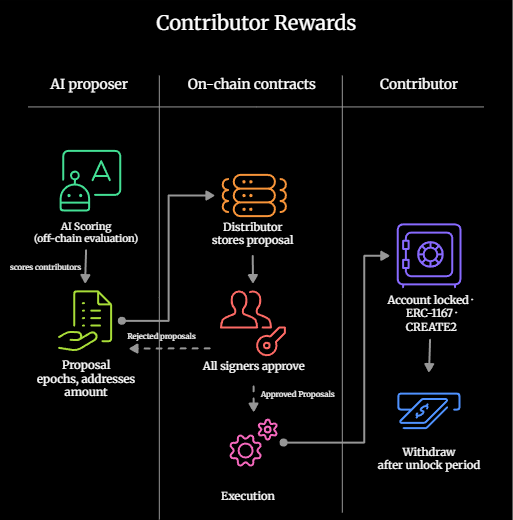
BLOK Capital uses a structured, three-layer reward pipeline to distribute $BLOKC tokens to contributors, combining AI-driven scoring, human approval, and on-chain execution into a single trustless flow.
Scoring and Proposal#
At the end of each reward epoch, an AI system evaluates contributor activity off-chain across the protocol's defined contribution categories. It then submits a distribution proposal on-chain: a list of contributor addresses paired with their $BLOKC reward amounts for that epoch.
The proposal is validated by the distributor contract before being stored. If an error is detected before approval begins, the proposer can cancel and resubmit within the same epoch.
Multi-Signer Approval#
AI scoring systems can hallucinate, misattributing contributions, inflating amounts, or omitting contributors entirely. The multi-signer approval layer exists specifically to catch this before any tokens move. Every designated signer independently reviews the proposed distribution and must approve it before execution can proceed.
If a signer identifies an error, such as an incorrect amount, a missing contributor, or a batch that doesn't reflect the actual work done, they withhold approval. The proposal stalls, signers communicate their feedback to the AI proposer, and the proposer cancels the batch and submits a corrected one. This rejection and resubmission cycle continues until the distribution accurately reflects contributor output and all signers are satisfied.
This is not a threshold multisig: every signer approves, or the distribution does not execute. The contract tracks approvals per signer and prevents double-approvals. No single entity, not the AI proposer, not any one signer, not the protocol team, can unilaterally move reward tokens. Contributors can be confident that the rewards they receive have passed a final human review, not just automated computation.
Permissionless Execution#
Once every signer has approved, anyone can trigger execution. The contract performs a final validation (proposal exists, not already executed, approval count met), then transfers $BLOKC to each contributor's predicted account address in a single transaction.
State is updated before transfers occur, following the checks-effects-interactions pattern to prevent reentrancy.
Contributor Accounts#
Tokens go into individual contributor accounts, dedicated smart contracts deployed as ERC-1167 minimal proxy clones using CREATE2 deterministic addressing. ERC-1167 defines a minimal bytecode implementation that delegates all calls to a fixed implementation contract, making each clone cheap to deploy while sharing audited logic across all accounts.
Because CREATE2 produces a predictable address from a fixed set of inputs (the implementation contract, the contributor's wallet address, and the factory address), the distributor sends tokens to that predicted address at execution time, even before the contributor has deployed their account.
When the contributor later deploys their account by calling the factory, the tokens are already there. This eliminates any sequencing dependency between distribution and account setup, allowing the protocol to distribute to any number of contributors in a single transaction.
Token Lock and Governance#
Tokens remain locked in the contributor account until a fixed unlock timestamp shared across all accounts. During the lock period, voting power is delegated to the contributor: locked $BLOKC counts toward governance from day one.
After unlock, the contributor can withdraw a specific amount to any address, or sweep the full balance to their own wallet. No protocol involvement is required at withdrawal time.
How Rewards Are Earned#
The sections above describe how settled rewards are secured and distributed on-chain. This section describes the earning side that comes first: who can take part, what counts as a contribution, how each post is scored, and how a provisional score becomes a settled reward that feeds the distribution proposal.
Today, contributions are public posts on X (Twitter) about BLOK Capital. The scoring and settlement described here happen off-chain; only settled rewards are ever proposed on-chain.
Who Can Earn#
Taking part is self-serve, and approval is automatic once both accounts are connected and pass the checks:
- Sign in with Google. This creates your contributor identity and a smart account used for reward attribution.
- Connect Discord. You must be a member of the official BLOK Capital Discord server.
- Connect X. Your X account must have at least 250 followers.
- Both your X account and your Discord account must have been created before 2026.
You must also be of the age of majority in your jurisdiction and legally permitted to receive $BLOKC. Approval is required before any post can earn, and posts published before you were approved do not earn.
What Earns Rewards#
- Original public posts on X that mention $BLOKC or @blok_cap.
- Replies and reposts do not count.
- Up to two posts per day earn rewards, counted by the UTC day the post was published. Any further posts that day are recorded but score zero.
- The full text of long posts and any attached images (charts, screenshots, diagrams) are read and judged.
- Likes, views, reposts, and follower count are not scored. Reach is not part of the score, so it cannot be bought or farmed for a higher reward.
How Each Post Is Scored#
Posts are scored daily. An AI judge reads each post and checks every claim it makes against the official BLOK Capital documentation at docs.blokcapital.io. Each claim is marked as supported, contradicted, unsupported, or not applicable, and the score is derived from those verdicts together with how substantive the claims are, the originality of the writing, and the overall quality.
Posts that score well:
- Original posts that explain how BLOK Capital works.
- Specific, checkable claims that match the documentation. The more substance, the higher the score.
- Written in your own words and framing.
Posts that score zero:
- Empty praise, such as "great project" or a single emoji.
- Reposting or rewording something that has already been scored, in any language.
- Copying sentences straight from the documentation.
- Posts that appear to be machine generated.
Each post's score converts into a $BLOKC amount. Reward amounts are discretionary and are not wages or a guarantee of any value.
Provisional Rewards and Settlement#
The amount you see first is provisional. About seven days after a post is scored, it is re-checked and the reward is settled (confirmed). This delay is a deliberate safety window, and it is the last point at which a reward can be reversed at no cost, before it is proposed on-chain.
A reward is removed if, at settlement, the post has been:
- deleted, made private, or its account suspended,
- edited into something materially different from what was scored, or
- found to duplicate another contribution. Where two posts match, the earliest post keeps the reward and the later one is removed.
Only settled rewards are owed. Settled amounts are what the on-chain distribution proposal, described earlier on this page, pays out.
Claiming and the Lock#
Settled $BLOKC accrues in your rewards vault and stays locked until May 1, 2027, a fixed date that cannot be accelerated or overridden by anyone, including the team. As described in Token Lock and Governance above, your voting power is delegated to you during the lock, so locked $BLOKC counts toward governance from day one.
After the unlock date you can claim, which sweeps your full balance to your smart wallet. Before then, any claim attempt is refused while the lock is in force.
Requesting a Human Review#
Because scoring is automated, you can request a human review of any score. Contact the team through the official Discord or X channels. A record of how each post was assessed is kept and is reviewed on request.
The #BLOKC Contest Is Separate#
From time to time BLOK Capital runs a separate contest, such as the "Explain BLOK to a Friend" contest, which uses the #BLOKC hashtag. Contest entries are judged only for that contest. They are not counted or paid as regular $BLOKC contribution rewards.
Community Walkthrough#
Our Developer Relations Engineer Rohit Purkait put together a full breakdown of this reward system in action: how AI scores every contribution, why every distribution needs unanimous signer approval, how it's all verified on-chain, and why followers or likes never factor into payouts.
Last updated:
Edit this page (opens in a new tab)