Diamond
Diamond Architecture Overview
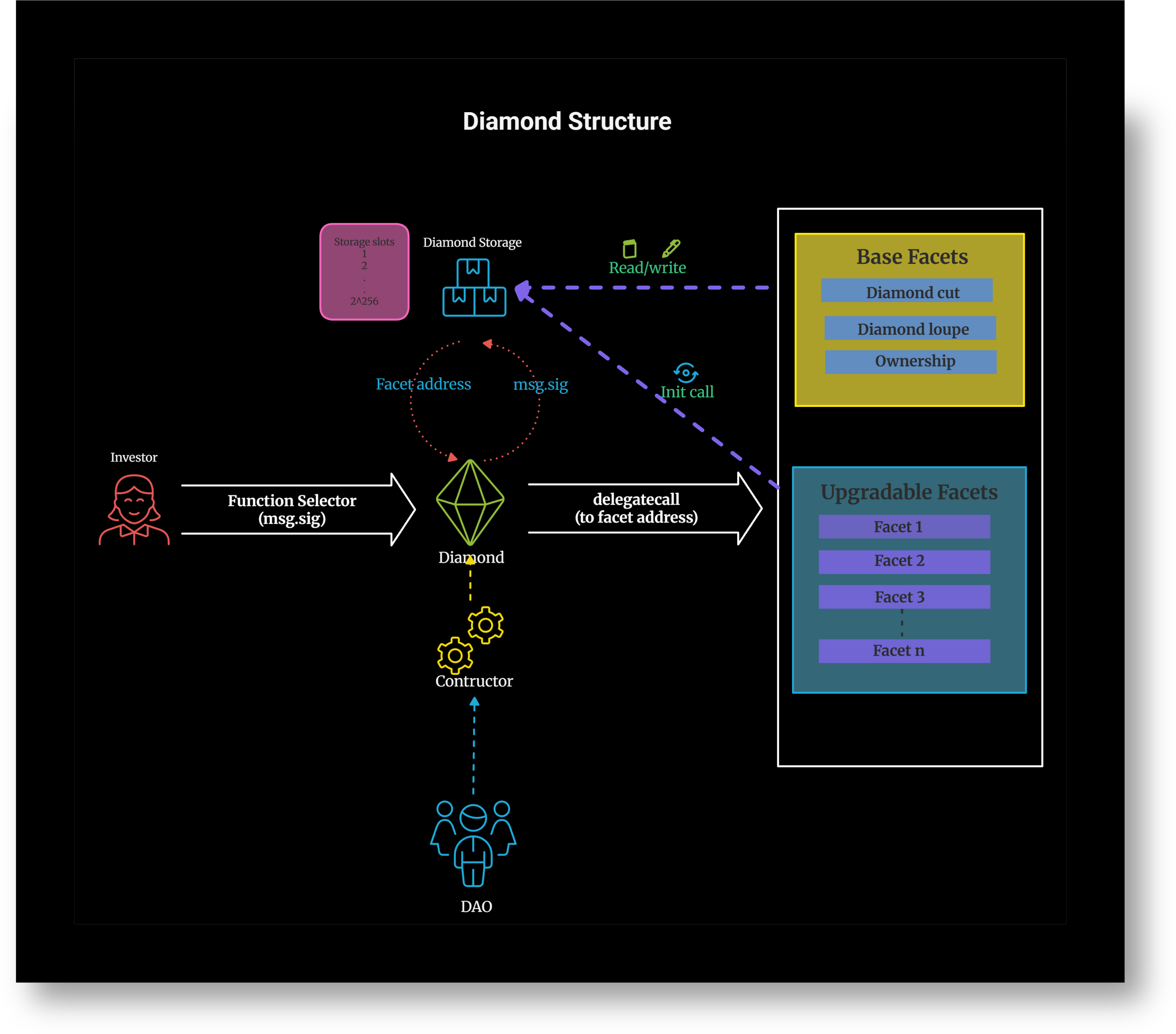
The Diamond architecture is a modular smart contract system designed for long-lived, evolving protocols.
At its core, a Diamond is a single contract address that represents the protocol. That address never changes. Only the functionality gets changed.
Instead of treating upgrades as “replacing a contract,” Diamonds treat upgrades as restructuring a system adding new capabilities, removing obsolete ones, or refining existing behavior, all without disrupting state or users.
This architecture is intentionally built for protocols that grow, diversify, and evolve after launch.
How the Diamond Thinks About Logic
A Diamond does not contain application logic directly.
Instead, it maintains a registry that maps function selectors to external logic modules called facets as we saw in proxy contracts. Each facet is responsible for a specific domain of behavior governance, strategy execution, accounting, risk controls, or protocol extensions.
When a function is called on the Diamond, it resolves which facet owns that function and executes it in the Diamond’s context. All state lives in one place. All behavior is composed around it.
Upgrade Model
Upgrades in a Diamond are explicit, granular, and auditable.
Rather than redeploying or swapping an entire implementation, upgrades operate at the function level:
→New functions can be added
→Existing functions can be replaced
→Unused functions can be removed
Each change is recorded on-chain, creating a clear historical record of how the protocol evolved over time.
Upgrades are not hidden rewrites. They are deliberate architectural changes.
Why This Matters
The Diamond architecture is designed for protocols that:
- Cannot fit into a single contract
- Expect multiple independent feature domains
- Need transparent, controlled upgrades
Instead of building “one big contract,” the protocol becomes a composable system whose structure can adapt as requirements change.
How BLOK Capital Uses Diamonds
BLOK Capital uses the Diamond architecture to model the protocol as a collection of independent financial capabilities unified under one address.
Index execution, asset strategies, accounting rules, and governance logic are implemented as separate facets. Each can evolve independently without affecting user balances or integrations.
This allows BLOK Capital to introduce new strategies, refine execution logic, or upgrade risk controls while preserving protocol continuity and user trust.
The Diamond becomes not just a contract, but the stable identity of the system itself.